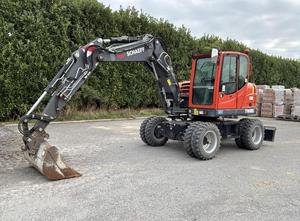
Used Wheeled Excavators for Sale 6


Wheeled excavators provide full excavation capability on rubber tyres with road-legal mobility, eliminating the trailer transport that tracked excavators require for movement between sites. Travel speeds of 35-40 km/h on public roads allow wheeled excavators to drive between job sites under their own power. Popular applications include urban utility installation and maintenance, highway maintenance work, railway maintenance, and any contractor operation that involves frequent site changes. Leading manufacturers include Caterpillar, Komatsu, Volvo, Liebherr, Hyundai, and Doosan.

Used wheeled excavators on Exapro serve utility contractors and maintenance operations. Filter by operating weight, manufacturer, and equipment options. Submit an enquiry through the listing page for specifications.

Wheeled excavators address a specific operational profile that crawler excavators cannot match — applications where the machine needs to move between sites frequently without the time, cost, and regulatory complexity of trailer transport. Urban utility contractors who work multiple jobs per week, highway maintenance crews who travel the highway network, railway maintenance operations that move along track segments, and municipal works departments serving multiple sites all benefit from the road mobility that wheeled excavators provide.

Operating weights on wheeled excavators range from approximately 10 tonnes (compact urban utility machines) through 25-30 tonnes (full-capability machines matching typical tracked excavator performance). At the lighter end, wheeled excavators compete with and often replace mini excavators for utility work where road mobility matters more than confined-space capability. At the heavier end, the machines provide capability equivalent to similarly-sized crawler excavators for applications where the trade-off for wheeled mobility is acceptable.

The trade-off wheeled excavators accept for their mobility is ground pressure and stability. Rubber tyres create much higher ground pressure than crawler tracks, limiting wheeled excavator operation on soft ground where crawler machines can work productively. Outriggers or stabilisers extend from the machine to provide stability during excavation work — without deployed outriggers, wheeled excavators have significantly reduced lifting and digging capacity compared to crawler equivalents.

Steering and travel configurations affect wheeled excavator applications. Front-wheel-steering (conventional steering) is adequate for highway travel but limits manoeuvrability on-site. All-wheel-steering with crab steering and four-wheel-steering modes dramatically improve manoeuvrability in confined worksites. Highway travel speeds of 35-40 km/h require road-legal equipment including lights, mirrors, and load-rated tyres.

Cab and operator station design on wheeled excavators typically reflects the highway travel requirement — travel-focused controls, road vehicle instrumentation, and seat configuration optimised for extended travel alongside excavation work. The operator experience differs from crawler excavators even when operating in excavation mode.

The wheeled excavator market is particularly strong in European cities and suburban environments where the road mobility provides genuine productivity advantages. The market is less developed in North American construction where transport distances and configurations favour tracked machines with trailer transport.

When evaluating used wheeled excavators on Exapro, verify tyre condition and remaining tread life (tyres are expensive replacements on heavy equipment), check outrigger/stabiliser function and wear, inspect steering system condition on all wheels, test travel transmission and braking for highway travel safety, and verify the cab road-legal equipment completeness and condition. Wheeled excavators from established urban utility contractors typically come with detailed operating and transport histories.