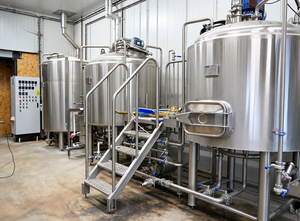
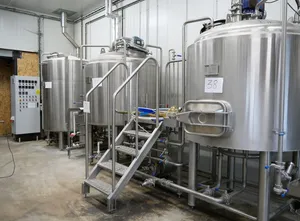
Used Brewery Equipment for Sale 85


Brewery equipment produces beer through the standard brewing process — malting, mashing, lautering, boiling, whirlpool clarification, cooling, fermentation, conditioning, and packaging. Brewhouse equipment (mash tun, lauter tun, brew kettle, whirlpool) handles the wort production phase. Fermenters (typically cylindroconical tanks) handle the fermentation and conditioning phases. Filling, bottling, and kegging equipment completes the production line. Leading manufacturers include Krones Steinecker, Ziemann Holvrieka, GEA, and specialty craft brewery equipment manufacturers.

Used brewery equipment on Exapro serves craft breweries, microbreweries, and expanding commercial breweries. Filter by equipment type and batch size. Submit an enquiry through the listing page for details.

The brewery equipment market has changed dramatically over the past two decades with the explosive growth of craft brewing. Where the historical brewery equipment market was dominated by large industrial brewing equipment manufacturers serving a relatively small number of major brewers, the current market serves thousands of craft breweries alongside the continuing industrial brewing sector. This expansion has created active used equipment markets at multiple scales.

Brewhouse equipment size defines the production capacity of the brewery. Small pilot breweries use 5-10 hl (hectoliter) brewhouses for very small production volumes. Microbrewery brewhouses of 10-30 hl serve typical craft brewery production. Production-scale craft brewhouses of 50-100 hl serve growing craft breweries. Industrial brewery brewhouses of 200-1,000+ hl serve commercial brewing operations.

Mash tun design determines the mashing process capability. Infusion mashing (temperature held constant) is simpler; step mashing (temperature incrementally increased) provides more process flexibility for different beer styles. Mash tun insulation quality, temperature uniformity, and agitation/raking systems all affect mash efficiency and consistency.

Lauter tun (or mash filter) separates the wort from spent grain after mashing. Lauter tun design with proper false bottom, underletting system, and drainage capability affects wort clarity and extraction efficiency — factors that affect beer quality and production economics.

Brew kettle configuration affects boiling process. Direct fire heating, steam heating, and electric heating each provide different energy characteristics. Internal or external wort boiler systems, whirlpool configuration (separate whirlpool tank vs combined kettle-whirlpool), and the general process flow affect both production capability and operating efficiency.

Fermentation tank selection determines both capacity and beer style capability. Cylindroconical fermenters (CCT) dominate modern brewing — the conical bottom collects yeast for removal, and the cylindrical construction provides efficient fermentation. Horizontal unitanks, upright fermenters, and open fermenters serve specific beer style requirements where traditional fermentation approaches produce distinctive beer characteristics.

Glycol cooling systems provide the temperature control required for controlled fermentation and cold conditioning. Cooling jacket coverage on tanks, glycol chiller capacity, and the general cooling infrastructure must match the total thermal load of the brewery operation.

Used brewery equipment comes from multiple sources. Craft brewery closures (unfortunately increasing in saturated markets) release equipment sets onto the used market. Brewery expansions replace smaller brewhouses with larger systems, releasing the original equipment. Industrial brewery consolidations sometimes release substantial equipment packages. Each source presents different opportunities and considerations.

When evaluating used brewery equipment on Exapro, verify stainless steel grade and sanitary surface finish (304 is acceptable for most brewing but 316 may be preferred for certain applications), check heating and cooling jacket integrity through pressure testing, inspect CIP coverage and effectiveness, test pump and valve function on installed systems, and confirm that process control systems match your intended operational practices. Brewery equipment packages that include utilities (chiller, air, hot liquor tanks, cold liquor tanks) offer substantially more value than brewhouses alone.